


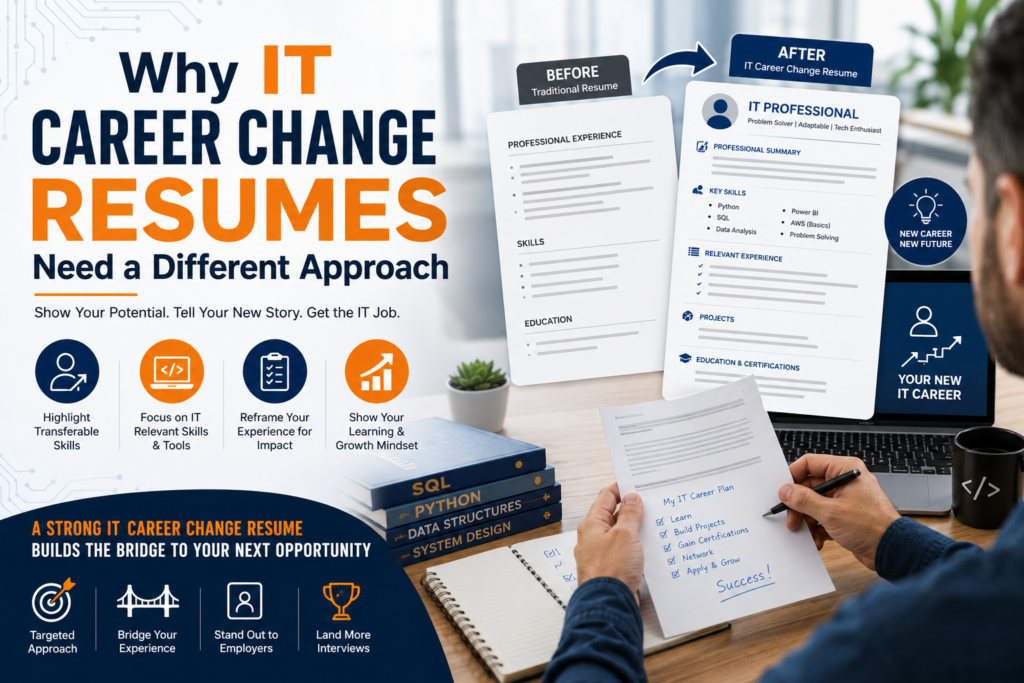
A Career Change Resume IT Jobs Australia has to do something a normal resume doesn’t: convince a hiring manager you can do a job you’ve never technically had. Short answer: it’s absolutely possible with no formal IT experience, but the resume has to be built differently structured around transferable skills, hands-on projects, and certifications, not a work history that doesn’t exist yet. “No experience required” doesn’t mean employers expect nothing; it means they’re screening for potential and evidence of effort instead of a job title.
This guide walks through exactly how to structure a career-change resume for IT jobs in Australia, what entry-level IT roles actually pay in 2026, and the specific rewording moves that turn a non-IT work history into something an IT hiring manager takes seriously.
Is It Realistic to Get an IT Job in Australia With No Experience?
Yes more realistic than most career-changers assume. A few things are working in your favour right now:
- ICT roles remain on Australia’s persistent skills shortage list, and entry-level help desk and support roles are consistently advertised as “no experience necessary” or “training provided”
- Many employers explicitly offer paid traineeships that combine real work with a nationally recognised qualification
- Help Desk and Tier 1 Support roles are built around customer service, communication, and problem-solving skills most career-changers already have from retail, hospitality, admin, or customer-facing roles
- Australia’s tech sector spending is projected to keep growing, and companies are hiring across all levels, not just senior roles
The catch is that your resume has to actively make this case employers won’t infer your transferable skills from a job history that looks unrelated on the surface.
For a live view of current entry-level openings, see SEEK: Information Technology, No Experience jobs.

What Entry-Level IT Jobs in Australia Actually Pay
Before you write a career-change resume for IT jobs in Australia, it helps to know what you’re realistically aiming for. Entry-level pay is modest but climbs quickly once you have 1–2 years of real experience on the resume.
| Entry Role | Average / Range (AUD) |
| Help Desk Technician (national average) | Average $59,779/yr; entry-level (<1 yr) around $44,926, range $37,000–$59,000 |
| IT Support Specialist (entry-level) | Average $51,847/yr for <1 year experience |
| IT Help Desk (Glassdoor, national) | Average $63,000/yr; typical range $56,000–$71,500 |
| IT Support (general, Indeed) | Average $77,234/yr across all experience levels |
| Helpdesk Technician (SEEK) | Average $65,000–$85,000/yr depending on location and employer |
| Support Analyst, IT (entry-level, Help Desk/Desktop Support) | Average $54,656/yr; range $51,000–$62,000 |
Most career-changers land their first IT role in the $45,000–$65,000 range, then move to $65,000–$85,000 within 12–18 months once they have genuine on-the-job experience to show. It’s a lower starting point than some other career changes, but the trajectory afterward is strong IT roles have some of the widest salary growth of any entry-level sector in Australia.
Career-Change Resume for IT Jobs Australia: City-by-City Demand
Entry-level IT demand isn’t identical everywhere. Sydney and Melbourne have the highest volume of help desk and support roles; Adelaide and Perth are considered especially accessible for entry-level candidates; Canberra’s government and defence sector consistently hires IT support staff with structured training pathways.
Sydney entry-level IT roles — the highest volume of help desk and support openings nationally. View Sydney courses
Melbourne entry-level IT roles — a growing tech hub with strong work-life balance and steady entry-level hiring. View Melbourne courses
Brisbane entry-level IT roles — growing steadily, strong take-home value once cost of living is factored in. View Brisbane courses
Perth entry-level IT roles — considered one of the more accessible markets for genuine entry-level candidates. View Perth courses
Adelaide entry-level IT roles — smaller volume but consistently rated as one of the easiest cities to break into IT support. View Adelaide courses
Canberra entry-level IT roles — government and defence-driven demand, often with structured traineeships built in. View Canberra courses
How to Structure a Career-Change Resume for IT Jobs
A career-change resume for IT jobs in Australia should follow a specific order — leading with what you can prove today, not what you’re missing.
| Resume Section | What Goes In It |
| Header | Name, phone, email, city/state, LinkedIn URL — no photo, no headshot for Australian applications |
| Career summary (3–4 lines) | Who you are, the role you’re targeting, and your strongest transferable skill — written for the new industry, not the old one |
| Core / Key skills | 6–10 bullet skills matched to the job ad’s language — technical (software, tools) and transferable (stakeholder communication, problem-solving) |
| Certifications & training | Any completed or in-progress IT courses, certificates, or bootcamps listed with dates — this section carries extra weight when you have no formal IT experience |
| Projects (if no IT work history) | 2–3 hands-on projects, labs, or portfolio pieces with a one-line outcome for each — substitutes for missing job experience |
| Work experience | Previous roles reframed around transferable achievements (troubleshooting, customer support, process improvement), not just duties |
| Education | Formal qualifications, most recent first — include relevant coursework if your degree isn’t IT-related |
For general resume formatting standards employers expect, see the Robert Half 2026 Salary Guide and resume resources.
The 5 Rewording Moves That Make a Non-IT History Work
- Reframe customer service as “end-user support” — handling complaints, troubleshooting issues, and de-escalating frustrated customers is functionally similar to Tier 1 help desk work.
- Turn “process improvement” language into technical language — if you streamlined a workflow, describe it as you would a systems or process fix, using outcome-focused verbs.
- Quantify everything you can — “resolved 40+ customer issues per shift” reads far stronger than “handled customer enquiries.”
- Lead with certifications, not job titles — if you’ve completed a Certificate IV, CompTIA A+, or similar, that credential should appear near the top, not buried at the bottom.
- Match the language of the job ad directly — most Australian employers and recruiters use ATS software that scans for exact keyword matches before a human ever reads the resume.
Step-by-Step: From Career-Changer to Hired in IT
- Get a foundational IT credential first. Even a short course changes how your resume reads it signals genuine commitment, not just interest. Explore the IT Fundamentals for Career Changers course to get started.
- Build 2–3 small hands-on projects. A home lab, a troubleshooting log, or a simple network setup gives you real material to talk about in interviews.
- Write the resume around the target job ad, not your past job title. Rewrite your summary and skills section for each application. See our Career-Change Resume Writing course for templates and examples.
- Apply to traineeships and “no experience necessary” listings first. These roles are specifically built to hire and train people like you — they’re the highest-probability path to your first IT job.
- Prepare to explain your career change clearly in interviews. A confident, specific answer to “why IT, why now” matters as much as the resume itself.
- Once hired, keep building toward a specialisation. Help desk is the entry point, not the ceiling — most people move into networking, cloud, or security within a few years. See our IT Career Pathways course for what comes next.
Is a Career Change Into IT Worth It in 2026?
For most people with strong communication and problem-solving skills, yes. The entry point is modest, but the trajectory afterward both in pay and in the range of specialisations available is one of the strongest of any career-change path in Australia. It’s most worth it for:
- People currently in customer service, retail, admin, or hospitality who already have strong transferable skills
- Anyone willing to invest in a short course or certification to strengthen a resume with no IT work history
- Career-changers targeting traineeships, which are specifically designed to hire people with no prior IT experience
It’s a slower first year than some other transitions, but the ceiling is high once you’re in and building toward a specialisation.
Frequently Asked Questions: Career-Change Resume for IT Jobs Australia
Can I get an IT job in Australia with absolutely no experience?
Yes — many Australian employers advertise entry-level IT and help desk roles as “no experience necessary” or offer paid traineeships that combine work with a recognised qualification.
What should a career-change resume for IT jobs include if I have no IT work history?
Focus on a strong summary targeted at the role, a skills section matched to the job ad, any certifications or training, 2–3 hands-on projects, and your previous work experience reframed around transferable skills like troubleshooting and communication.
How much do entry-level IT jobs pay in Australia?
Most entry-level IT support and help desk roles pay between $45,000 and $65,000 to start, with pay typically rising to $65,000–$85,000 within 12–18 months of real experience.
Do I need a certification to change careers into IT?
It’s not always mandatory, but a short course or certification (like CompTIA A+ or a Certificate IV) significantly strengthens a resume with no IT work history and often speeds up hiring.
Which Australian city is easiest to break into an entry-level IT job?
Adelaide and Perth are often considered more accessible for genuine entry-level candidates, while Sydney and Melbourne offer the highest overall volume of roles.
How do I explain a career change to IT in a job interview?
Focus on a clear, specific reason for the change, tie your previous experience directly to transferable skills the role needs, and be ready to talk through any hands-on projects or training you’ve completed.
Ready to start? Explore the IT Fundamentals for Career Changers course at JobReadyPrograms.com, or check out our guides on Career-Change Resume Writing and IT Career Pathways to plan your next move.