


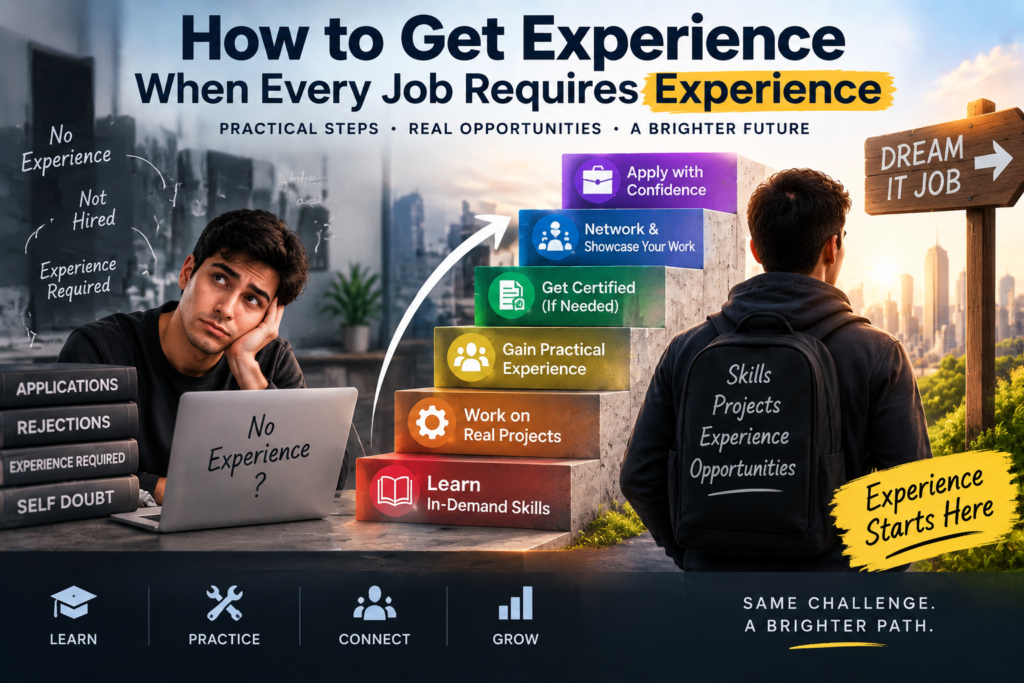
The honest answer to how to get experience when every job requires experience is that you build it yourself, deliberately, before an employer ever hands you a job title. Job seekers across Sydney, Melbourne, Brisbane, Perth, Adelaide and Canberra spend months applying and getting nowhere because they’re waiting for permission to gain experience, when the candidates who actually break through go and create it. This guide covers seven concrete, low-cost ways to build genuine, resume-worthy experience without needing someone to hire you first.
Why “Get a Job to Get Experience” Is a Trap, Not a Rule
The catch-22 of needing experience to get a job, and a job to get experience, only holds if you treat a paid job as the only source of legitimate experience. It isn’t. Employers across Australia increasingly accept self-directed projects, freelance work, volunteering and structured training as valid proof of capability especially at the entry level, where they’re really screening for evidence you can do the work, not for a specific job history.
Seven Real Ways to Get Experience Without a Job

1. Volunteer for a Not-for-Profit or Community Organisation
Why it works:
Charities, sporting clubs and community groups across Brisbane, Perth and Adelaide constantly need help with marketing, admin, IT support, bookkeeping and event coordination, and are far more open to inexperienced volunteers than paid employers are to inexperienced hires. This produces a genuine reference, a real outcome to describe, and often a lasting professional connection.
2. Take On Freelance or Micro-Client Work
Why it works:
A single small paid project building a simple website, managing social media for a local business, cleaning up a spreadsheet counts as real client work on a resume, even if the payment was modest. Sydney and Melbourne freelance platforms make it realistic to land a first small project within weeks, not months.
3. Build a Self-Directed Project and Document It Properly
Why it works:
A well-documented personal project a data analysis on a public dataset, a small app, a design portfolio piece, a business case study demonstrates applied skill even without a client or employer attached to it. The key is documenting your process and decisions, not just the finished result, since that’s what an interviewer actually wants to hear about.
4. Complete a Structured Internship or Job-Ready Program
Why it works:
Internships and structured job-ready programs are specifically designed to produce real, workplace-relevant experience in weeks rather than years, often including a live client project or simulated workplace scenario. Employers across Canberra and Adelaide’s government and enterprise sectors increasingly recognise these programs as a legitimate substitute for a first job.
5. Contribute to Open, Public Projects in Your Field
Why it works:
Depending on your target field, this could mean contributing to an open-source software project, writing guest articles, running a small community workshop, or helping answer questions in a professional online community. It’s visible, verifiable proof of engagement with your field that costs nothing but time.
6. Shadow or Assist Someone Already Doing the Job
Why it works:
A short, informal shadowing arrangement or informational interview with someone in your target role — even unpaid, even just a day or two — gives you real workplace context to reference in interviews and often opens a direct referral into that person’s network.
7. Turn a Hobby or Past Role Into Relevant Case Studies
Why it works:
Most people already have more relevant experience than they realise, buried inside hobbies, previous unrelated jobs, or informal projects — running a community Facebook group is marketing experience, organising a family event is project coordination. The work here is framing, not creating something from nothing.
Turning These Methods Into Resume-Ready Proof
| Method | Time to Build | What to Put on Your Resume |
| Volunteering | 2–8 weeks | Organisation name, role, one measurable outcome |
| Freelance/micro-client work | 1–4 weeks per project | Client type, deliverable, result achieved |
| Self-directed project | 1–6 weeks | Project name, tools used, problem solved |
| Internship/job-ready program | 4–12 weeks | Program name, project delivered, skills demonstrated |
| Open contribution/community work | Ongoing | Platform or community, contribution type, visibility achieved |
A Realistic 60-Day Plan to Build Real Experience
- Days 1–14: Pick one or two methods above that fit your target field and your available time.
- Days 15–35: Complete a first volunteer role, freelance project, or self-directed project, and document it as you go.
- Days 36–50: Write up the experience properly outcomes, tools, decisions ready to add to your resume.
- Days 51–60: Update your resume and LinkedIn with the new experience and start applying with genuine proof behind you.
Programs That Help You Build Experience Faster
A structured job-ready program compresses months of self-directed effort into a guided timeline, combining a certification with a real project so you finish with both proof of skill and proof of experience at the same time.
- Explore a full Job Ready Program built specifically to help you build real, resume-ready experience fast.
- Build hands-on data experience with a Data Analytics Course.
- Build hands-on IT support experience through the full IT Courses
- Explore the full IT and professional skills catalogue at Logitrain, Australia’s long-established training provider.
Further Reading
- Volunteering opportunities across Australia through Volunteering Australia.
- Current internship and entry-level program listings on SEEK.
Final Tips Before You Start
- Pick methods that produce something concrete and describable, not just “exposure.”
- Document as you go write down what you did and the outcome immediately, not weeks later.
- Treat this as a genuine project with a deadline, not an open-ended someday task.
Ready to stop waiting and start building real experience? Explore the full Job Ready Program at jobreadyprograms.com and build the certification, project and experience that actually gets you hired across Sydney, Melbourne, Brisbane, Perth, Adelaide and Canberra.