


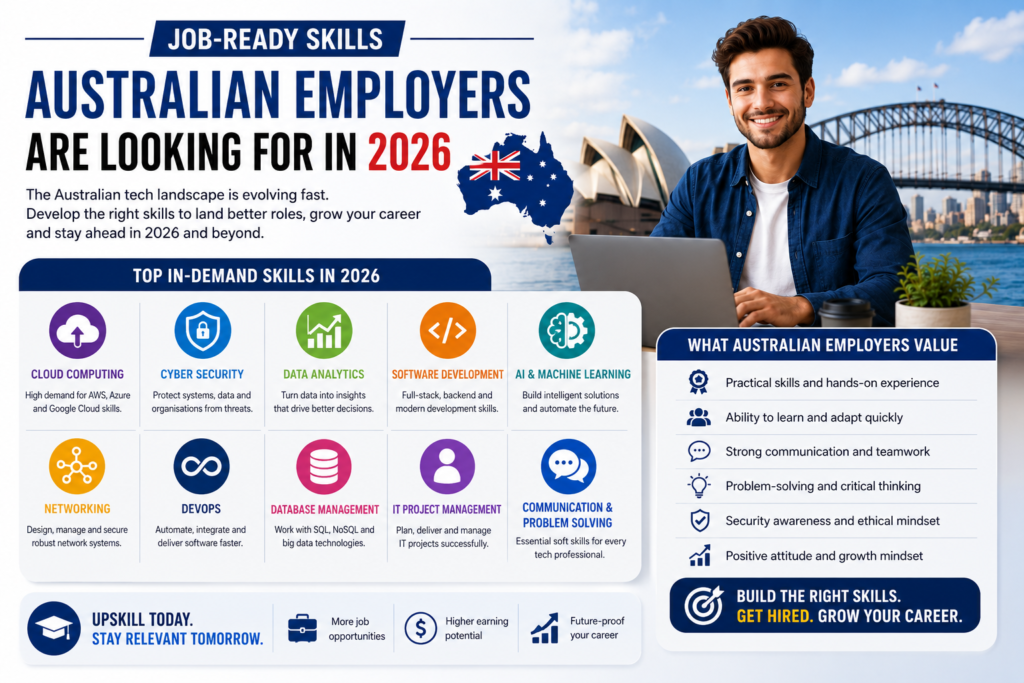
Job ready skills Australia are shifting fast, and employers in 2026 are hiring less on qualifications alone and more on proof that a candidate can contribute from day one. Whether you’re switching careers, finishing study, or re-entering the workforce, understanding exactly which skills employers are screening for gives you a clear, practical target instead of a vague sense that you should “upskill.” This guide breaks down the technical, digital and soft skills driving hiring decisions across Australia right now.
The common thread across almost every growing industry technology, healthcare, finance, government and trades is a demand for people who are job ready rather than simply qualified. That means practical, demonstrable skills, not just a certificate on a resume.
Why Job-Ready Skills Matter More Than Ever in 2026
Australian employers are dealing with tighter budgets and longer hiring processes, which means they’re increasingly reluctant to hire someone who needs months of training before becoming productive. Job ready candidates people who can demonstrate real, applied skills through certifications, projects or hands-on experience are consistently prioritised over candidates with theoretical knowledge alone.
Top Technical and Digital Skills Australian Employers Want

Data Analysis and Reporting
From retail to healthcare, employers want staff who can read a dashboard, interpret trends and make a basic recommendation from data not just data analysts, but general staff who are data-literate. Tools like Excel, Power BI and basic SQL show up constantly in job ads outside of dedicated data roles.
Cloud and Cybersecurity Fundamentals
As more Australian businesses move core operations to the cloud, a working understanding of cloud platforms (Azure or AWS) and basic cybersecurity hygiene has become an expected baseline in IT, finance and operations roles alike.
AI Tool Fluency
Employers increasingly expect staff to use AI tools productively and responsibly drafting content, summarising documents, automating repetitive tasks rather than treating AI as optional or unfamiliar.
Project and Agile Delivery Skills
Understanding how a Scrum team runs a sprint, or how a PRINCE2-managed project moves through stages, is now useful well beyond formal project management roles, since so many teams operate in an Agile or hybrid delivery structure.
Soft Skills That Get Candidates Hired
Technical ability gets you shortlisted; soft skills often decide who actually gets the offer. The skills employers repeatedly flag in 2026 hiring include:
- Clear written and verbal communication, especially for remote and hybrid teams
- Adaptability — comfort with changing priorities, tools and processes
- Problem-solving under ambiguity, without waiting for step-by-step instructions
- Collaboration across departments and time zones
- Time management and the ability to prioritise competing deadlines
In-Demand Job-Ready Skills by Category
| Category | Top Skills in Demand | Fastest Path to Build Them |
| Data & Analytics | Excel, Power BI, SQL basics | Short data analytics certification course |
| Cyber Security | Security fundamentals, risk awareness | CompTIA Security+ or entry-level cyber course |
| Project & Agile Delivery | Scrum, PRINCE2, stakeholder management | Scrum Master or PRINCE2 certification |
| Business & Admin | Reporting, process documentation, CRM tools | Business analyst or admin-focused job ready program |
| Cloud & IT Support | Azure fundamentals, troubleshooting, ticketing systems | Azure fundamentals or IT support certification |
Job-Ready Skills Demand by City in Australia
| City | Strongest Hiring Sectors | Demand Level |
| Sydney | Finance, tech, professional services | Very High |
| Melbourne | Retail, government, technology | Very High |
| Brisbane | Government, construction, utilities | High |
| Canberra | Federal government and defence | High |
| Perth | Resources, mining technology | Moderate–High |
| Adelaide | Defence, health, manufacturing | Moderate |
How to Close the Skills Gap Quickly
The fastest way to become job ready in Australia isn’t a full university degree it’s a structured, short-form program that combines certification with practical, hands-on application. A well-chosen job ready program should:
- Target a specific in-demand role rather than general knowledge
- Include hands-on projects or labs, not just theory
- Lead to a recognised certification employers actually screen for
- Offer guidance on resume building and interview preparation
Ready to Build Job-Ready Skills?
If you’re ready to close the gap, compare job ready training programs to find the fastest path from where you are now to a role employers are actively hiring for in 2026.
Frequently Asked Questions About Job-Ready Skills in Australia
What are the most in-demand job-ready skills in Australia right now?
Data literacy, cloud and cyber security fundamentals, Agile/project delivery skills, and strong communication consistently rank among the most requested skills across Australian job ads in 2026.
Do I need a degree to be considered job ready?
Not always. Many employers now accept a relevant short-form certification plus demonstrable hands-on skills in place of a full degree, particularly for entry-level and career-change roles.
How long does it take to become job ready?
Most focused, short-form programs take between 4 and 12 weeks to complete, depending on the role and prior experience, and can be paired with hands-on projects to build a practical portfolio.
Which Australian cities have the strongest demand for job-ready candidates?
Sydney, Melbourne and Canberra currently show the strongest overall hiring demand, though Brisbane, Perth and Adelaide all have strong sector-specific opportunities.
Start building the skills employers want — explore job ready programs at jobreadyprograms.com and take the first step toward your next role.