


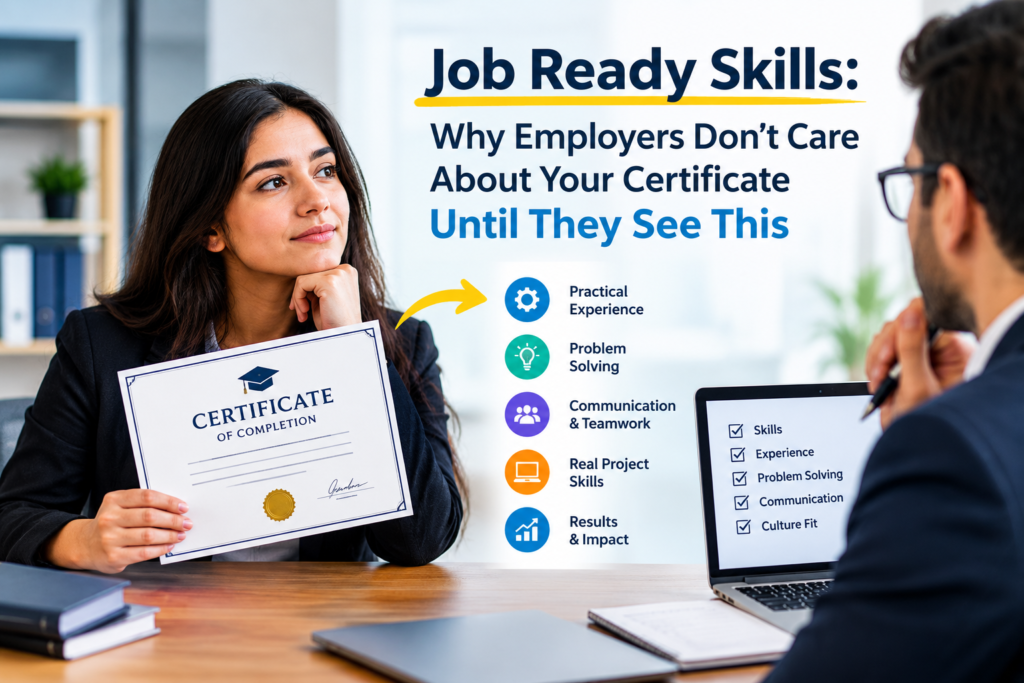
Job ready skills are what hiring managers look for before they care about the certificate on your résumé. That sounds harsh if you have just spent months and money earning a qualification. But once you understand how employers actually screen candidates, it becomes good news, because job ready skills can be built, shown and proven.
This guide explains what employers really see when they read your application, the proof that makes a certificate count, and how to turn your training into a job offer. It is written for graduates, career changers and migrants who are working towards a first or next role in Australia.
The Uncomfortable Truth About Your Certificate
A certificate says you completed a course or passed an exam. It does not say whether you can solve a problem at 4pm on a Friday, explain a technical issue to a manager, or work with a team you have only just met. Those are the things employers are paying for.
Imagine a hiring manager with eighty applications and a list of skills to fill. Half the candidates hold the same certificate. It stops being a differentiator and becomes the minimum. What separates one candidate from the next is evidence of job ready skills, and the certificate only opens the door to that conversation.
Do Employers Care About Certifications? What Hiring Managers Really Think
Yes, they do, but not in the way most candidates expect. Employers value certifications as a signal that your knowledge has been checked against a recognised standard. In technical fields, vendor programs such as Microsoft credentials give recruiters a quick way to filter applicants.
The problem is that a certification answers only one question: “Does this person know the material?” Employers have three more questions. Can you apply it? Can you communicate it? Will you fit into our workplace? Without job ready skills to answer those, a certificate carries far less weight than candidates hope.
Job Ready Skills: The Proof Employers Want to See
So what is the “this” that makes an employer care about your certificate? It is visible, believable proof of five things.

1. Hands-on projects you can describe
A certificate plus a project beats a certificate alone. Building a small cloud environment, analysing a real dataset, testing an application or documenting a business process gives you something concrete to point to. When an interviewer asks “what have you actually done?”, a project gives you a confident answer.
2. Real workplace experience
Even a short, structured stint of practical experience shows you understand deadlines, feedback and team communication. For candidates new to the Australian job market, local experience also reassures employers about workplace expectations. It is one of the fastest ways to turn training into credibility.
3. Current skills, not just old credentials
Technology moves quickly. A certificate from several years ago may not reflect the tools a business uses today. Employers prefer candidates who can show recent, relevant learning, especially in cyber security, cloud computing and data. Checking labour market information from Jobs and Skills Australia can help you choose skills that are in demand.
4. A résumé that shows results
Many résumés list certifications like a shopping list. Employers want to see what you did with your knowledge: what problem you solved, which tools you used and what changed as a result. A résumé and cover letter tailored to each job ad turns a list of credentials into a story.
5. Confidence in the interview
An interviewer will test whether you can explain your knowledge in plain language. Candidates who have practised answering behavioural questions, and who can talk about a real project, stand out immediately. This is where career coaching often makes the difference between a second interview and a polite rejection.
Certificate Only vs Certificate Plus Job Ready Skills
| What employers look at | Certificate only | Certificate plus job ready skills |
| Proof of ability | A pass mark or completion record | Projects and practical exercises you can explain |
| Work experience | None to show | Relevant experience or practical placement |
| Résumé impact | A list of credentials | Results, tools and outcomes for each skill |
| Interview performance | Theory-based answers | Confident, example-based answers |
| Employer confidence | Uncertain, needs further checking | Higher, because ability is visible |
How to Turn Your Certificate Into Job Ready Skills
You can start today, even before you enrol in anything new. Work through these steps in order:
- Read ten job ads for the role you want and highlight the tools, tasks and certifications that repeat.
- Match each highlighted item to something you have actually done. Where there is a gap, that is your training target.
- Choose instructor-led training with hands-on labs and projects, not only exam preparation.
- Build one small portfolio project and write a short summary of the problem, your approach and the result.
- Seek practical experience, such as an internship, volunteering or freelance work, and add it to your résumé.
- Rewrite your résumé and cover letter for each application, using the language of the job ad.
- Practise interview answers out loud, using real examples from your projects and experience.
That sequence is the heart of a job ready program. It combines certification, hands-on practice and career coaching so that your certificate arrives with proof attached.
Which Job Ready Program Fits Your Career Goal?
The team at Job Ready Programs offers instructor-led pathways that combine certification-focused learning, hands-on projects and career coaching. You can explore all job ready programs or start with the area that matches your background:
- Business Analysis: for people who want to connect business needs with practical solutions.
- Cloud Computing: for those aiming at cloud and infrastructure roles.
- Cyber Security: for graduates and career changers moving into security.
- Data Analysis: for future analysts, reporting and business intelligence roles.
- Database: for anyone who wants to work confidently with data and SQL.
- IT Job Ready: a broad pathway for starting or restarting an IT career.
- Project Management: for those who want to plan, lead and deliver projects.
- Software Testing: for detail-minded people who want to work in quality assurance.
- Web Development: for learners who want to build modern websites and web applications.
If you are unsure which path suits you, read the program FAQs or contact the team for guidance. Check the specific program page for details on inclusions, schedule and certifications before enrolling.
Job Ready Skills Training in Melbourne, Sydney, Brisbane, Perth, Adelaide and Canberra
You do not have to relocate to build job ready skills. Programs are available through classroom, live virtual and in-house options, with flexible weekday, weeknight and weekend timing. See local information for Melbourne, Sydney, Brisbane, Perth, Adelaide and Canberra, or view all program locations. If you work in IT already, the Australian Computer Society is also a useful place to find professional networking and skills information.
Job Ready Skills and Certificates: Frequently Asked Questions
Do employers care about certifications?
Yes, particularly in technical fields, because certifications verify knowledge against a recognised standard. They care most when the certification is backed by practical examples, projects and experience.
Is a certificate enough to get a job?
Rarely on its own. A certificate helps you pass the first screen, but employers still want proof you can do the work, communicate well and fit the team.
Can I get a job with a certificate and no experience?
It is possible, especially for entry-level roles, but it is easier when you add projects, practical experience and a tailored résumé. Structured programs are designed to help you build these quickly.
How do I show job ready skills on my résumé?
Describe what you did, the tools you used and the result, for each project or role. Put the most relevant certification, project and experience near the top, and match the language of the job ad.
Which certification should I get first?
Pick the one that appears most often in job ads for the role you want. Then pair it with hands-on practice so you can talk about it confidently.
How long does it take to become job ready?
It depends on your starting point, the field and how many hours you can study each week. Many learners combine training with part-time study, so ask for a schedule before you commit.
Final Thoughts: Make Your Certificate Count
Your certificate is not worthless. It is simply not enough on its own. Add hands-on projects, practical experience, a sharper résumé and interview confidence, and you give employers exactly what they are looking for: proof of job ready skills.
Ready to make your certificate count? Book your place now, explore our programs or call 1300 649 299 to speak with the team about the right pathway for you.