


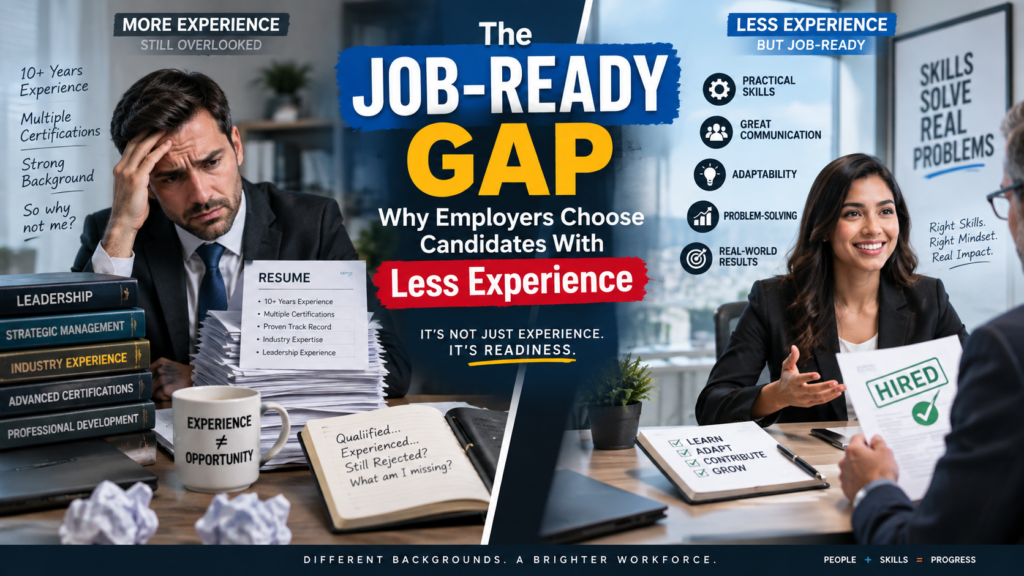
It doesn’t seem fair. A candidate with eight years on their CV gets passed over for someone with two years and a certificate. If you’ve watched this happen, or lived it yourself, you’re not imagining things. Employers really are choosing job-ready candidates with less experience over more seasoned applicants, and once you understand why, it stops feeling random and starts looking like a pattern you can work with.
The short version: years of experience tell an employer what you’ve been exposed to. Job readiness tells them what you can actually do on day one. In a hiring market that’s shifted hard toward proving capability over listing history, that difference decides who gets the offer.
The Shift Behind the Job-Ready Gap
This isn’t a hunch, it’s a measurable shift in how hiring actually works now. Research from TestGorilla’s 2025 State of Skills-Based Hiring report found skills-based hiring has become the norm rather than the exception, with the large majority of employers now using it, and most agreeing it leads to better hiring outcomes than resume screening alone.
Separately, LinkedIn’s Economic Graph research found employers are increasingly evaluating entry-level and career-change candidates on demonstrated skills rather than job titles, meaning a well-prepared career changer can now genuinely compete with someone who has years in a related role but hasn’t kept their practical skills current.
Put simply: experience used to be a proxy for capability. Now employers test for capability directly, and that closes the gap between a newcomer and a veteran faster than most people expect.
Why Employers Actually Choose Less Experienced, Job-Ready Candidates
- They come without outdated habits or legacy ways of working that need to be unlearned.
- They’ve often trained on current tools and platforms, while long-tenured candidates may be working from dated processes.
- They can demonstrate hands-on, recent project work rather than relying on years-old achievements.
- They typically cost less to hire, while still delivering the practical output the role needs.
- They show clear motivation and coachability, qualities employers rate highly when technical fundamentals are already covered.
What ‘Job-Ready’ Actually Means to an Employer
Job-ready doesn’t mean flawless. It means an employer can trust you to contribute in your first weeks without heavy hand-holding. Employers consistently look for a specific combination of signals when they use that phrase, whether they say it out loud or not.
1. Practical, Demonstrable Skills
Employers want proof you can do the task, not just describe it. A portfolio, a completed project, or a certification backed by hands-on labs carries far more weight than a bullet point claiming familiarity with a tool.
2. Confidence Under Real Conditions
Interviews increasingly include scenario-based or practical assessments. Candidates who’ve trained on realistic, workplace-style exercises walk in prepared for this, while candidates who’ve only studied theory often freeze.
3. Communication and Workplace Readiness
Technical skill gets you shortlisted. Communication, problem-solving under pressure, and the ability to work with a team get you hired and kept. Employers weigh this more heavily than most job seekers expect.
4. Career Coaching Polish
Small things matter: a tailored resume, a confident interview answer, a clear explanation of a project you’ve completed. Candidates who’ve had career coaching consistently outperform equally skilled candidates who haven’t.
5. Certification Backed by Application
A certification still matters, but paired with a completed hands-on project it becomes proof rather than a claim, which is exactly what closes the job-ready gap.
How to Become the Job-Ready Candidate Employers Want
Closing this gap isn’t about starting over, it’s about training the right way. A structured, instructor-led program that combines certification training, hands-on projects, and career coaching does exactly what a self-study certificate alone can’t: it proves you’re job-ready, not just qualified on paper.

This is the model behind the
Job Ready Program, which pairs certification-focused training with real hands-on projects and dedicated career coaching, resume support, and interview preparation, so graduates leave able to demonstrate capability, not just describe it.
Depending on the direction you want your career to take, you can build job-ready skills across a number of in-demand pathways:
- IT Job Ready for a broad foundation across IT support and infrastructure
- Cyber Security for candidates targeting security analyst and SOC-style roles
- Cloud Computing for roles built around modern cloud platforms and infrastructure
- Data Analysis for candidates moving into data-driven decision-making roles
- Business Analysis for those bridging business needs and technical delivery
- Project Management for candidates building structured delivery and leadership skills
- Software Testing for a practical entry point into quality assurance
- Web Development for candidates building hands-on coding and front-end skills
- Database for candidates focused on data infrastructure and administration
Job Ready Training Across Australia
Because local employer expectations and industries differ from city to city, training close to your target job market matters. The Job Ready Program is delivered across major Australian cities, with flexible full-time, part-time, and live online options for learners balancing work or family commitments.
- Melbourne, supporting candidates entering Victoria’s technology, finance, and professional services sectors
- Sydney, with strong demand across IT, business analysis, and corporate roles
- Brisbane, where infrastructure and technology roles continue to expand
- Perth, supporting resources, engineering, and IT-adjacent career changers
- Adelaide, with growing demand across defence, manufacturing, and technology
- Canberra, where government and public-sector employers value verified, job-ready skills
Closing the Gap: Practical Steps You Can Start Today
- Choose training that includes hands-on projects, not exam preparation alone.
- Build a small portfolio you can walk an interviewer through, even one solid project helps.
- Get career coaching on your resume and interview answers before you start applying.
- Target roles that value demonstrated skill, many now explicitly advertise skills-based hiring.
- Keep learning after certification, staying current is itself a job-readiness signal.
Frequently Asked Questions
Why do employers hire job-ready candidates over experienced applicants?
Employers increasingly hire based on demonstrated, current skills rather than years of experience, because skills-based hiring has proven more predictive of on-the-job performance than experience or education alone.
What does ‘job-ready’ mean in a job application?
It means a candidate can contribute with minimal onboarding, backed by practical, recent, hands-on skills, clear communication ability, and confidence under real workplace conditions, not just theoretical knowledge.
Can a career changer with no experience become job-ready?
Yes. Structured programs that combine certification training, hands-on projects, and career coaching are specifically designed to help career changers and newcomers demonstrate job-ready capability, often within months.
Ready to Close Your Own Job-Ready Gap?
If you’re ready to move from qualified on paper to genuinely job-ready, explore the program or book a call with the team to find the right pathway for your goals and city.
Explore the Job Ready Program | Book Now | Contact Us | Call 1300 649 299