



Why employers reject qualified candidates, even when a resume ticks every box on paper? It is one of the most frustrating experiences in the modern job search. You have the degree, the certification and the years of experience, yet the rejection emails keep coming. You are not imagining it. Recent hiring research shows that 58% of applicants say they have been turned down despite being qualified for the role, while almost half of hiring managers admit they have overlooked genuinely capable people simply because those candidates could not demonstrate their skills clearly during the process.
The truth is that being “qualified” and being “job ready” are two different things in today’s market. Employers reject qualified candidates every day, not because those candidates lack ability, but because something in the application, interview or presentation failed to prove that ability. This guide breaks down exactly why employers reject qualified candidates so often, and what employers are looking for instead, so you can fix the gap and get hired faster.
Why Employers Reject Qualified Candidates More Often Than You Think
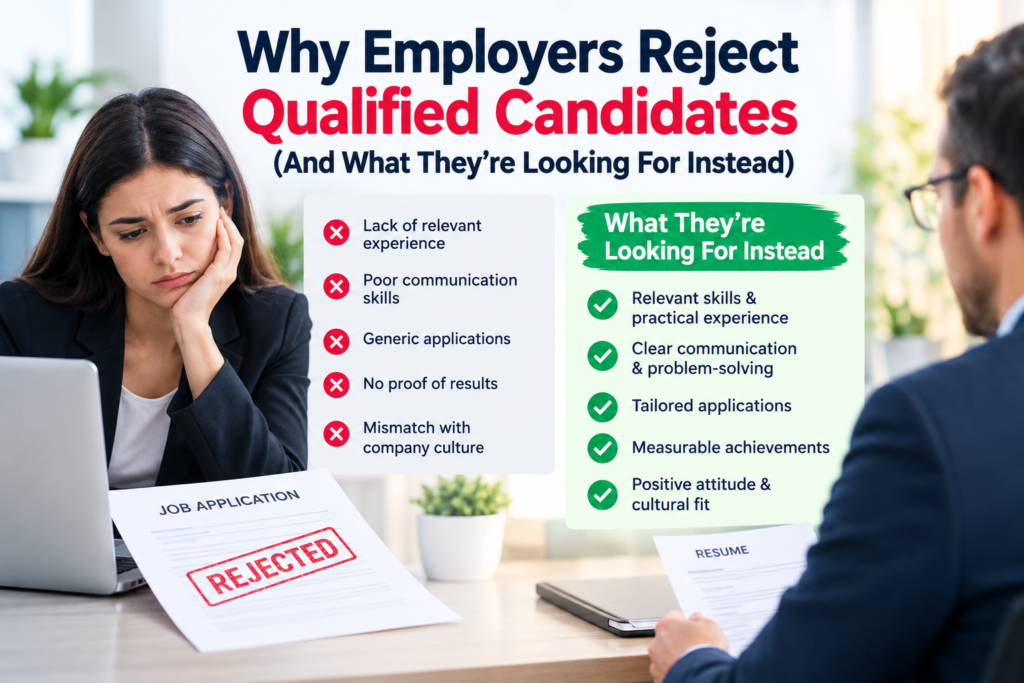
Large-scale hiring data backs this up. An analysis of more than 500,000 merit-based hiring decisions found that the leading rejection reasons were not a lack of formal qualifications at all — they were mismatches in experience type, industry background and role fit. In fact, being overqualified rejects almost as many candidates as being underqualified. Here are the six reasons employers reject qualified candidates most often.
1. “Qualified” on Paper Isn’t the Same as Job Ready
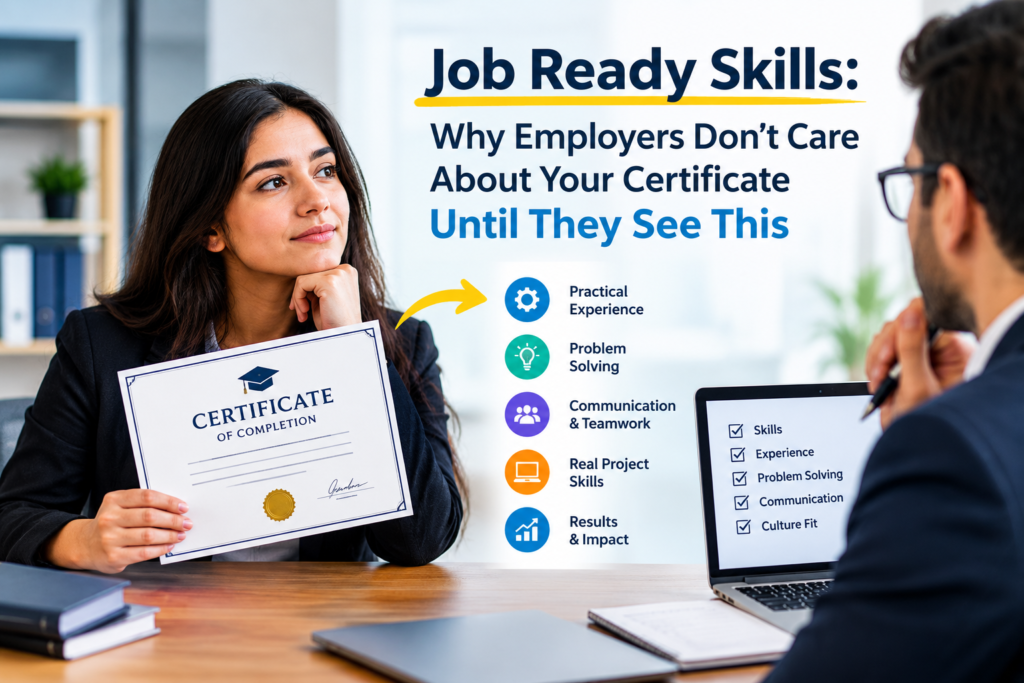
A degree or certificate proves you learned the theory. It does not prove you can apply it under real workplace pressure, on a real deadline, with a real team. This is the single biggest reason employers reject qualified candidates: the resume promises competence, but nothing in the application demonstrates it in action.
2. Weak Communication and Generic Applications
Hiring managers report that weak communication and an unprofessional tone are the fastest way to get rejected when applicant volume is high, followed closely by poor attention to detail. A generic cover letter, a resume that reads like everyone else’s, and vague interview answers all signal the same thing to a hiring manager: this person hasn’t put in the work to stand out.
3. No Evidence of Adaptability or Problem-Solving
Employers today are less interested in what you know and far more interested in how you think under uncertainty. Around 85% of organizations now name adaptability as the single most critical hiring criterion, ahead of technical expertise. If a candidate cannot describe a real example of adjusting to change, solving an unexpected problem or learning a new tool quickly, employers reject qualified candidates in favour of someone who can.
4. Wrong Fit for the Role or Industry
Industry-background mismatch and role mismatch are consistently among the top rejection reasons, even ahead of “not qualified.” A strong resume in the wrong industry, or aimed at the wrong seniority level, gets filtered out before a human even reads it properly.
5. Overqualified or Underqualified for This Specific Role
It surprises many job seekers, but being overqualified rejects candidates almost as often as being underqualified does. Employers worry an overqualified hire will leave quickly or expect a higher salary later, so they pass even on excellent candidates.
6. Poor Interview Preparation
Rehearsed, generic answers and an inability to connect past experience to the specific role are consistently cited as reasons employers reject qualified candidates at the final stage, after the resume has already done its job.
What Employers Are Actually Looking for Instead
If employers reject qualified candidates for these reasons, the fix is straightforward: show employers what they are actually looking for, rather than assuming your qualifications will speak for themselves.
Practical, Hands-On Skills They Can See
Employers want proof of applied skill real projects, hands-on training and portfolio-style evidence not just a transcript. Practical, project-based learning is now weighted more heavily than classroom theory alone.
Communication and Soft Skills
Multiple recent studies converge on the same point: soft skills such as communication, teamwork and emotional intelligence are now rated by 92% of talent professionals as equally or more important than technical ability. Some hiring managers report disqualifying candidates specifically for weak soft skills, even when technical ability was strong.
Certification and Proof You Can Do the Job
Certifications remain one of the fastest ways to prove capability to a skeptical hiring manager, especially when paired with hands-on projects rather than exam preparation alone.
Confidence and Interview Readiness
Clear, confident communication from the very first email or application is one of the three traits hiring managers say most reliably separates candidates who get hired from everyone else in a crowded pool.
Adaptability and Initiative
Employers want to see ownership: examples of a candidate identifying a problem and acting on it without being told to. This single trait consistently separates shortlisted candidates from rejected ones.
How to Stop Getting Rejected and Start Getting Hired
The good news is that every reason employers reject qualified candidates above is fixable with the right training. The Job Ready Program is built specifically to close this gap. Instead of theory-only study, it combines certification-focused learning, hands-on projects and career coaching (resume, interview and job-readiness support) so you walk into interviews with proof, not just promises.

Popular career pathways that directly target the skills employers are looking for include:
- Business Analysis — practical, stakeholder-facing problem-solving skills
- Cloud Computing — in-demand, hands-on technical certification
- Cyber Security — applied, project-based security training
- Data Analysis — real datasets, not just theory
- Project Management — leadership, communication and delivery skills
- IT Job Ready — a broad, workplace-ready technology pathway
Every pathway includes career coaching, so the same interview and communication weaknesses that cause employers to reject qualified candidates are addressed directly, not left to chance.
Job Ready Training Available in Cities Across Australia
The Job Ready Program runs instructor-led and live virtual training in major cities, so wherever you’re based, you can build the practical skills employers are looking for: Melbourne, Sydney, Brisbane, Perth, Adelaide, and Canberra.
Frequently Asked Questions
Why do employers reject qualified candidates so often?
Employers reject qualified candidates mainly over fit, communication and proof of applied skill not a lack of formal qualifications. Weak interview preparation, generic applications and no evidence of adaptability are the most common causes.
What are employers looking for instead of qualifications alone?
Employers want hands-on, demonstrable skills, strong communication, adaptability, initiative and confident interview performance, backed by certification where relevant.
How can I stop getting rejected for roles I’m qualified for?
Build practical, project-based proof of your skills, tailor every application, and practise interview communication. Structured programs like the Job Ready Program combine certification training with career coaching to address this directly.
Does certification training really help candidates get hired?
Yes — certification paired with hands-on, project-based learning gives hiring managers concrete proof of ability, which is exactly what closes the gap between being qualified and being job ready.
Ready to stop hearing “unfortunately” and start hearing “you’re hired”?
Book a call with the Job Ready Program team and build the practical, job-ready skills employers are looking for.